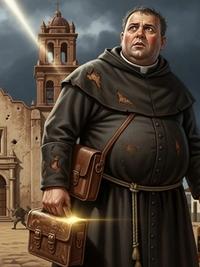
There's this moment at the end of The Power and the Glory that has stayed with me since I first read it. The whiskey priest is being led to his execution. He's about to die for refusing to abandon his priesthood in anti-Catholic Mexico. And as he walks toward his death, he thinks to himself: "It would have been so easy to be a saint." That line is one of the most profound things I've ever read.
He's looking back over his life: the drinking, the illegitimate child, the fear, the weakness. He can see it all clearly now. Every crossroad where he chose poorly. Every moment where virtue was right there, waiting to be chosen. From this side of those decisions, they look so obvious. So simple. It would have been so easy to choose differently.
I understand that clarity. As a husband and father, I can look back and see my own crossroads. The moments I chose comfort over sacrifice. Times when I struggled with addiction. Small choices that seemed insignificant at the time but added up.
But here's the thing about the whiskey priest that I almost missed the first time I read the book: he's walking to his execution. Willingly. He's accepting a martyr's death. This broken, flawed priest, the one who can see all his failures so clearly, never gave up. At any point, he could have walked away. He could have apostatized. He could have thrown away his sacramentals and abandoned his vocation altogether. The authorities would have let him live. All he had to do was stop being a priest, and he didn't.
Through all of his weakness, he kept going. He kept dispensing the sacraments. He kept hearing confessions. He kept being a priest when being a priest meant death. Something held him to his vocation even when he couldn't hold himself to virtue, and that something was grace.
Greene understood this. The whiskey priest didn't persist through willpower. He wasn't a stoic hero gritting his teeth through adversity. He was a weak man held up by something stronger than himself. Every time he could have walked away and didn't, that was grace. Every time he stumbled back to his duty after falling, that was grace. The very fact that he never gave up is not something he can take credit for. That's the mercy of God refusing to let go of him.
I've learned this in my own life. The decision to stay the course, to keep showing up for my family, to not abandon my vocation even in my worst seasons: I used to think that was my own grit, my own determination. Now I know better. That was Christ holding onto me when I couldn't hold onto myself, and that changes everything.
Because if staying the course is grace, then I don't have to carry the weight of my past failures as condemnation. I can see them clearly (the whiskey priest was right about that, we do see our choices more clearly in hindsight) but I see them as a man who has been held, not as a man who white-knuckled his way through. The whiskey priest's regret is real. It would have been easier to become a saint if he'd made different small choices along the way. Those choices matter. They shape who we become. And I can let that wisdom guide me going forward: a commitment to choose better at the next crossroad, to cooperate more fully with grace when it's offered. But his faithfulness is also real. He chose to die rather than abandon his priesthood, and that choice, the choice to never give up, was the most important one he made.
Both things are true for me, too. I can see where I could have done better. That clarity is a gift, not a burden. It helps me make better choices today. But I also see that through all of it, I never stopped being a husband and father. I never walked away from my vocation. And here's what I've come to understand: if I had walked away, none of the other choices would matter. You can't grow in virtue if you've left the field. You can't become a better father if you've stopped being one. And I want to be clear about what I mean by staying. I don't mean simply not leaving. There are men who never walk out the door but who stopped trying long ago. That's not perseverance. That's just presence without purpose. The whiskey priest didn't just remain in Mexico; he kept trying to be a priest. He kept reaching for the sacraments, kept serving his people, kept striving toward his vocation even when he failed at it daily. That's what I mean by not giving up: not the decision to stay in the building, but the decision to keep reaching for holiness even when you keep falling short. The choice to stay, to keep going even when so many smaller choices were flawed, is the one that keeps all the other possibilities alive. It's the hinge on which everything else can eventually turn. And that decision wasn't really mine. It was grace, working in me, refusing to let me go.
The whiskey priest dies a martyr not despite his failures but carrying them with him. His weakness and his faithfulness coexist until the very end, and both are held together by something greater than himself. That's what being a father is. You carry your past and your faithfulness together. You see clearly where you could have done better, and you keep walking forward anyway. You learn from "it would have been so easy to be a saint" while also trusting that the grace which kept you in the fight is the same grace that's making you into one. The small choices matter. Make better ones when you can. The choice to never give up is the one that grace makes possible, and the one that makes all the others possible.
Your feedback helps us create better content