What We Believe Is How We Live: Honest Sinners and Hypocrites in The Three Musketeers
A Study Guide for The Three Musketeers
By Tyler and Sadie Woodley
"These people honor me with their lips, but their hearts are far from me." — Matthew 15:8 / Isaiah 29:13
"To obey in faith is to submit freely to the word that has been heard." — Catechism of the Catholic Church, 144
What We Believe Is How We Live
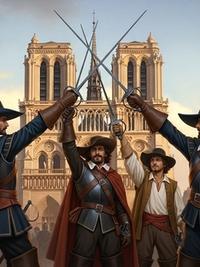
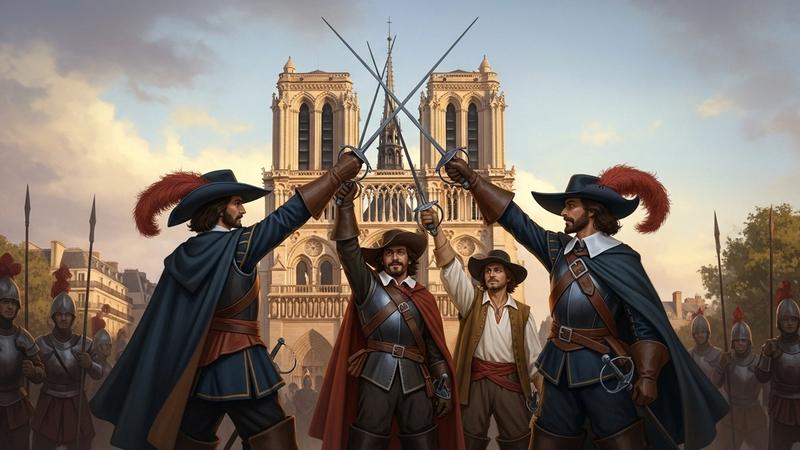
What do we truly believe? Not what we would say we believe if someone asked, but what we actually believe—down where our choices are made—shows up in how we treat people, in what we reach for when no one is looking, in what we do and do not do. If you want to know what a person truly believes, don't listen to what they say; watch what they do. A person's life is the most honest creed he or she could ever write. And Alexandre Dumas's The Three Musketeers — a swashbuckling adventure of duels, disguises, and "all for one" — turns out to be a wonderful place to watch that truth at work.
To be clear, Dumas was not writing a work of theology. By all known reports his intentions were to make money, not prompt moral reflection. He was a pioneer of the dime store paperback: popular adventures made to appeal to working-class readers. Dumas's goal was to build a story on an obvious contrast his readers could find deeply relatable. On one side he presented the four musketeers: rough, hard-drinking, hard-living soldiers, not a respectable one among them. On the other, the men who wore their faith on their sleeves and fluently spoke the language of God: Cardinal Richelieu most of all, and the devout assassin John Felton (both of whom were real-life figures who really did commit many of the political acts ascribed to them, including Felton being responsible for the assassination of the Duke of Buckingham). The ordinary reader would know at once whose side to take. We love the musketeers; we distrust the cardinal. And the remarkable part is that these instincts are not merely sentimental. At their root, they are deeply Christian.
For a Christian, the center of what we believe is not an idea or a set of rules, but a Person: Jesus Christ. Every doctrine, every devotion, every commandment of our faith exists for one reason: to bring us to Christ and conform us entirely to him. If one were to take Jesus out of the center of the Christian faith, then what is left is just religious furniture: real, sometimes even beautifully decorative, but entirely performative.
Dumas creates a world where the musketeers, for all their sins, live what they believe, while the men who proclaim Christ with their lips do not. Once you see the book through that lens, it stops being a costume drama and becomes something closer to a retelling of a Gospel parable.
The Men in Red
The real-life Cardinal Richelieu, born Armand-Jean du Plessis in 1585, entered the Church almost by accident—a family needed someone to hold a small diocese and its income. He quickly was ordained a bishop by age twenty-two. In real-life accounts the young bishop took his vocation seriously, preaching, visiting his parishes frequently, and even writing a catechism for ordinary people. But then he went to court, and over a decade something changed. Cardinal Richelieu rose to be the most powerful man in France after the king, a prince of the Church in red robes. Ultimately, for better or for worse, today the Cardinal is known more for his political acts than the pastoral.
The main reason for this is ascribed to the belief Richelieu actually lived by during his years at court—a political doctrine that later writers would call raison d'état, "reason of state." The good of the state comes first, and whatever serves the state is, for that reason, right. In other words, the end justifies the means. What is right is whatever works. Cardinal Richelieu is often regarded as the first European statesman to govern by it consistently. Machiavelli had described such a ruler a century before; Richelieu, a cardinal, became one.
But the reality is that "what is right is whatever works" is not compatible with Catholic teaching. The Church has always taught that intrinsically bad means can never justify a good end. Some things are simply wrong in themselves and cannot be made right by any good they might produce. We may not do evil so that good may come. Dumas uses the historical facts of how Richelieu actually governed to paint an artistic portrait of what was popularly thought to be the real creed in his heart. After all, Richelieu really did besiege the city of La Rochelle for more than a year and let tens of thousands of his own countrymen starve. He bankrolled Protestant armies against Catholic ones when it suited France. He kept ruthless agents (Dumas gives them a face in the cold and conscienceless—and entirely fictional—Milady de Winter), and put the sins of others to work as tools for his ends. Dumas lampooned Richelieu as a man ordained to shepherd souls but who used those souls merely as means to the state's ends. Dumas ultimately and unfortunately didn't take as many liberties with the character of Richelieu as a devout Catholic would have wished.
In The Three Musketeers Richelieu is the cold version of religious hypocrisy, while John Felton is the hot one.
Felton was in real life a fervent Puritan motivated by religious fervor into committing a political assassination. There is no evidence that a woman like the fictional Milady de Winter was involved in his decision, but Dumas portrayed him as a man who was an easy mark for exactly that kind of manipulation. In the novel Felton is shown to have a fanatic hatred underneath his false professions of faith. His character flaws cause him to go wherever his sins can get the most rationalization. Working on his religious zeal, his sense of righteous grievance, and the lust he tries to deny, Milady persuades Felton that the assassination of the Duke of Buckingham would be a holy act, the will of God. And Felton, with his lips full of Scripture, ends up driving a knife into the Duke. His faith is all fire and brimstone and arrogant certainty, and it ends in murder.
Dumas makes the point that Felton was not a cynic like Richelieu; he is shown as entirely sincere as far as his self-awareness takes him. But this sincerity is not the same as truth—a religion that is all fervent words and no real conformity to Christ can be steered into evil as surely as cold calculation. Dumas showed the cardinal using faith as a cover, while the Puritan used it as a weapon. Neither was living the gospel of the One he named.
It is worth noticing that in real life Felton and Richelieu were ideological enemies—a Catholic cardinal and a Protestant zealot would be on opposite sides of everything. And yet their failure is identical, which tells us that Dumas was not pointing to a Catholic problem or a Protestant problem, but a human one. Both men honored God with their lips, but neither let Him near the center of how they actually lived. "These people honor me with their lips, but their hearts are far from me," Matthew 15:8-9.
The Men Who Kept Their Word
Now turn to the other side of the book: Dumas was honest in his often hilarious and raw portrayal of the morality of the musketeers. They were not good men in any tidy sense. They drank to excess, gambled away money they didn't have, and famously fought deadly duels over trifling affronts to their honor. Athos was a brooding drunk haunted by a ruined marriage; Porthos was vain and courting a wealthy older woman for her money; Aramis kept one foot in the seminary and the other in a noblewoman's boudoir; and young d'Artagnan, the hero, got himself recklessly entangled with the cardinal's deadliest agent while courting a married woman. These men are not exactly models of virtue.
But Dumas caught the popular zeitgeist in showing that whatever the musketeers actually did claim to believe, they lived. Their creed was small and worldly (loyalty, friendship, courage, keeping your sworn word) but it was real, and they were willing to let it cost them everything. "All for one and one for all" wasn't just a slogan they recited; it was something they did, again and again, at the risk of their lives. They rode through the night, took wounds, and walked toward near-certain death for a friend or for a promise they made. Again and again Dumas showed that when a musketeer gave his word, it would hold. There was no gap in them between what they professed and how they lived. Their belief and their life were one.
To be clear, of course this is not a defense of their vices. Drunkenness and fornication and reckless violence are sins, and the novel's romantic dismissiveness about them shouldn't lead a Catholic reader into the same attitude. The point is not that the musketeers are good people. The point is that they aren't hypocrites. They never claimed the things Richelieu and Felton claimed. They never stood up and proclaimed themselves servants of Christ, and then betrayed the Lord. Instead they made small promises and kept them. It turns out that a small creed truly lived is a far less ruinous thing than a great creed merely professed.
Whose Company Christ Kept
Dumas, writing for ordinary readers, plainly wanted us to prefer the musketeers to the cardinal. What he may not have fully realized is how closely that instinct tracks the Gospel.
Over and over, Jesus kept company with the wrong people. He ate with tax collectors, who were universally and quite understandably despised as traitors. He let a known sinful woman wash his feet. The respectable, religious, doctrinally correct men of the time were scandalized, but Jesus never backed down. Instead he told those same religious leaders that "the tax collectors and the prostitutes are entering the kingdom of God ahead of you," Matthew 21:31. Why would Our Lord have declared that those open sinners would enter heaven ahead of the men who knew how to claim every word of God correctly?
Just before his verse, Jesus told the parable of the man who had two sons. He asked the first to go work in the vineyard; the boy said, "I will not," but then thought better of it and went. He asked the other the same; that one said, "Yes, sir, I will go," but he never went. Which of them, Jesus asks, actually did what his father wanted? Not the one with the obedient answer. The one who repented and then actually went and did the work.
Much of The Three Musketeers is contained in that parable. Richelieu and Felton are the son who said all the right words — Yes, Lord, I serve You — and then did not go. The musketeers are the son who said the crude thing, or nothing at all, and then actually went out and did the work of loyalty and sacrifice. And Jesus's verdict was that the one who did the father's will is simply the one who did it. This is why the instinct Dumas counted on in his readers is, in the end, a Christian instinct. Christ preferred the honest sinner who repents and does the right thing to the polished hypocrite who thinks saying the right thing is enough.
Why Belief Still Matters
Of course, there is a wrong turn we want to avoid here, and it is an easy one to take. Someone might walk away from all this thinking that belief doesn't really matter, then. What counts is just being sincere and loyal and decent, like the musketeers, and never mind the doctrines. That conclusion is not only wrong; it is the very mistake that ruined the men in red, dressed up in nicer clothes.
Christianity is not a vague spiritual feeling about God. Rather it makes definite claims: that God became man in Jesus of Nazareth, that Christ died and rose, that he founded a Church, that He will come again. Christians did not invent these things or settle them by majority vote. They were revealed by God and handed to us from outside ourselves. This revealed truth is the Deposit of Faith, and the task of the Church is to guard it and pass it on whole, not to trim it down to whatever a given age finds comfortable. Right belief—real assent to what God has actually revealed—is not optional or a matter of picking and choosing. Otherwise we end up only being sincere in our belief, not in God, but in whatever suits our ends, as both Richelieu and Felton demonstrate.
Richelieu may well have been sincere in his devotion to France, and Felton was almost certainly sincere in his conviction that God wanted Buckingham dead. Dumas shows that both men really did believe, but what they sincerely believed was false. It was what they wanted to believe, not what Jesus actually revealed. It led one to ruin souls and the other to murder. "It doesn't matter what you believe, so long as you're sincere" is not a generous idea, but a dangerous one. What we believe matters enormously, because that is what we will live out.
So the musketeers aren't the answer. They are only half of it. They show us that a creed must be lived. Anything truly believed shows up in the witness of our lives, and the loyalty of an honest sinner is worth more than the sermons of a hypocrite. But their creed is far too small. It reaches no higher than friendship and courage; it never reaches Christ at all. Ultimately the novel shows that the hypocrite has the words without the life, and the musketeer has a life without the full truth. The whole Christian essence is to have both: to believe what is actually true—the entire faith, the real Person of Jesus Christ at its center—and then to live that all the way down, the way the musketeers lived their small loyalties.
When we believe rightly all the way down, holding fast to the full Deposit of Faith, we discover that our faith is not a checklist to modify and mark off as we see fit. It is a relationship with a Person — Jesus Christ, who can be known, loved, followed, disobeyed, and returned to. This is exactly what Richelieu's political maneuvering and Felton's fanaticism both missed, to their terrible detriment.
The doctrine at the center of the Christian faith is never dull or in need of modification. The Creed tells the most astonishing story ever told: that the God who made everything came down into His own creation, was born poor, was killed by the very people He came to save, and rose. The dogma is not the dry part of the faith. The dogma is the drama.
Ultimately Dumas's novel has a message that certainly applies to our modern world. It's easy to fall into the same trap as either the hypocritical religious or the musketeers. We can stand in church every Sunday and say the Creed out loud, every word correct, while our real working beliefs about what matters have been quietly shaped by something else entirely. We can recite the faith but end up sleepwalking through it, or being comforted with our own smaller, manmade creed. The words stay correct, but the Person of Christ that animates them slowly becomes a stranger to us.
How can we avoid this pitfall? By the example of saints.
Faith That Becomes a Life
The Scriptures give us two people the Church holds up as the great models of faith in paragraphs 144 to 149. The first person is Abraham. God asked him to leave everything familiar and go to a land he had never seen, and Abraham went, in the words of Scripture, "not knowing where he was to go," Hebrews 11:8. His faith was not an opinion he held about God. Rather, his faith was the journey itself. He believed, and so he walked. This is the faith that God credited as righteousness—not just a thought or a spoken belief, but lived action.
The second person, whom the Church calls the most perfect example of all, is Mary the mother of Our Lord. When the angel told her that God was asking the impossible of her, she answered, "Let it be done to me according to your word," Luke 1:38. That one sentence is her whole faith, and it is also her whole life. She believed, and so she said yes, and the yes became everything that followed.
Here, at last, are the musketeers' wholehearted, all-for-one loyalty and the cardinal's true doctrine joined in the same person and aimed all the way up at God Himself. Abraham and Mary believed what was true, and they lived it without reservation. There is no gap in them at all between the creed and the life, because in them the creed becomes the life. This is what the Church means by the sequela Christi, the following of Christ. To have faith is not about admiring him from a distance, or reciting the right words about him, or merely holding the right beliefs in one's mind, but actually going where he goes and doing what he asks with our whole selves. The only witness that finally convinces anyone is a faith you can watch a person live.
So we end where we began: What we believe is how we live. If we truly believe in Jesus Christ and not merely recite him, then that belief will become visible in how we treat the people around us, in what we put first, in what we will and will not do. The really good news is that this is not a demand to be more impressive than we are. It is an invitation, and it is open even to wastrels and sinners. The Lord assures us at every moment that we are capable of far more than we think, not by our own strength, but by the grace of God at work in us. The poorest person who kneels and means it stands nearer to the kingdom than a cardinal or a zealot who doesn't.
Right belief is critical, but equally critical is the understanding that Christianity was never a set of beliefs with Jesus added on afterward. It was always a Person, offering his friendship and asking for our whole life in return. Every doctrine, every devotion, exists to bring us to him and to keep us near him, if we truly let it change how we live. The Three Musketeers is a beautiful reminder to put Jesus back at the center, every day.
Your feedback helps us create better content